Sprint Tools · Wickets
Enter one leg measurement and get every mark for a max velocity wicket run: a nine-step approach and 18 mini-hurdles, spaced from that athlete's own stride.
| Mark | Spacing | From start | Zone |
|---|
A starting layout. Watch the first runs and adjust by an inch or two for rhythm, posture and foot strike.
Outperform Motion · Free on iPhone and iPad
The same calculator lives in the free Outperform Motion app. It saves each athlete's leg length and latest wicket setup, builds group setups by level for a whole squad, and shares the marks straight to your notes or messages.
Measure
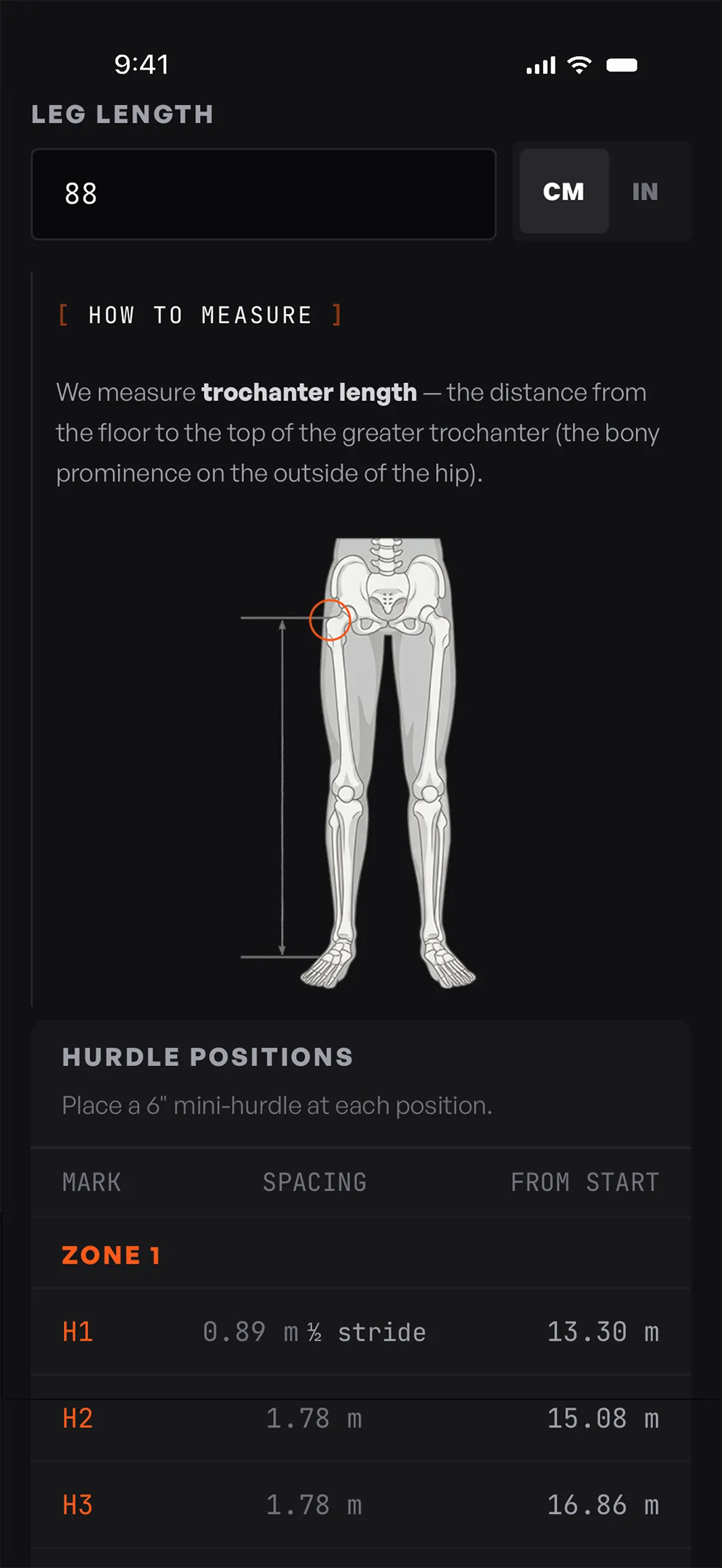
Use trochanter length: the distance from the floor to the top of the greater trochanter, the bony knob on the outside of the hip. The athlete stands barefoot and tall. Measure both sides and average them.
Set up
You need a tape measure longer than the full run, 18 six-inch mini-hurdles, and tape or chalk.
Progress
Each level spaces the three zones as a share of the athlete's estimated max stride. Low runs 80 to 85 percent, Medium 82.5 to 87.5, High 85 to 90. Max stride extension runs 97.5 to 102.5 percent and is for advanced athletes only. Start low and move up only when every run is clean.
Chart
Zone spacing on the Low setting for leg lengths from 28 to 40 inches, worked out with the same formula as the calculator. H1 sits at half the zone 1 spacing. Medium and High each add about two inches to every zone for most athletes.
| Leg | Zone 1 | Zone 2 | Zone 3 |
|---|---|---|---|
| 28 in71 cm | 4'7"1.39 m | 4'9"1.44 m | 4'10"1.48 m |
| 29 in74 cm | 4'9"1.44 m | 4'11"1.49 m | 5'0"1.53 m |
| 30 in76 cm | 4'11"1.49 m | 5'1"1.54 m | 5'2"1.59 m |
| 31 in79 cm | 5'1"1.54 m | 5'3"1.59 m | 5'5"1.64 m |
| 32 in81 cm | 5'3"1.59 m | 5'5"1.64 m | 5'7"1.69 m |
| 33 in84 cm | 5'5"1.64 m | 5'7"1.69 m | 5'9"1.75 m |
| 34 in86 cm | 5'7"1.69 m | 5'9"1.75 m | 5'11"1.80 m |
| 35 in89 cm | 5'9"1.74 m | 5'11"1.80 m | 6'1"1.85 m |
| 36 in91 cm | 5'11"1.79 m | 6'1"1.85 m | 6'3"1.90 m |
| 37 in94 cm | 6'1"1.84 m | 6'3"1.90 m | 6'5"1.96 m |
| 38 in97 cm | 6'2"1.89 m | 6'5"1.95 m | 6'7"2.01 m |
| 39 in99 cm | 6'4"1.94 m | 6'7"2.00 m | 6'9"2.06 m |
| 40 in102 cm | 6'6"1.99 m | 6'9"2.05 m | 6'11"2.12 m |
| Leg | Zone 1 | Zone 2 | Zone 3 |
|---|---|---|---|
| 28 in71 cm | 4'5"1.34 m | 4'6"1.38 m | 4'8"1.42 m |
| 29 in74 cm | 4'7"1.38 m | 4'8"1.43 m | 4'10"1.47 m |
| 30 in76 cm | 4'8"1.43 m | 4'10"1.48 m | 5'0"1.52 m |
| 31 in79 cm | 4'10"1.48 m | 5'0"1.53 m | 5'2"1.57 m |
| 32 in81 cm | 5'0"1.53 m | 5'2"1.58 m | 5'4"1.62 m |
| 33 in84 cm | 5'2"1.58 m | 5'4"1.63 m | 5'6"1.67 m |
| 34 in86 cm | 5'4"1.62 m | 5'6"1.67 m | 5'8"1.73 m |
| 35 in89 cm | 5'6"1.67 m | 5'8"1.72 m | 5'10"1.78 m |
| 36 in91 cm | 5'8"1.72 m | 5'10"1.77 m | 6'0"1.83 m |
| 37 in94 cm | 5'10"1.77 m | 6'0"1.82 m | 6'2"1.88 m |
| 38 in97 cm | 5'11"1.81 m | 6'2"1.87 m | 6'4"1.93 m |
| 39 in99 cm | 6'1"1.86 m | 6'4"1.92 m | 6'6"1.98 m |
| 40 in102 cm | 6'3"1.91 m | 6'6"1.97 m | 6'8"2.03 m |
Why wickets
Wickets are six-inch mini-hurdles set at a fixed spacing. The spacing fixes the stride length, so the athlete has to find the rhythm by putting the foot down under the hips instead of reaching for the next gap.
That is why coaches use them for max velocity mechanics: an upright posture, the knee coming up and through in front of the body, and the foot striking down and back close to the center of mass. The hurdle height asks for enough knee lift to clear it without hopping over.
Wickets also give you feedback you can see and hear on every run. A clipped hurdle, a reach into the next gap or a loud, flat contact tells you the spacing or the athlete's posture is off.
Program
Questions
It depends on the athlete's leg length and the point in the season. This calculator estimates max stride as leg length times 2.35 for women and 2.45 for men, then spaces three zones at a share of it: 80 to 85 percent early in the season, up to 85 to 90 percent in season, and 97.5 to 102.5 percent for max stride extension. For a male athlete with a 35 inch leg on the Low setting, that puts zone 1 at about 5 feet 9 inches and zone 3 at about 6 feet 1 inch. Across leg lengths of 28 to 40 inches on that setting, zone 1 runs from about 4 feet 5 inches for a 28 inch leg on a woman to about 6 feet 6 inches for a 40 inch leg on a man; the chart on this page lists every inch.
Twice a week, 48 to 72 hours apart, early in the session after a full warm-up. Most athletes do three to six runs with three to five minutes of rest, and stop when the rhythm breaks.
Measure trochanter length: floor to the top of the greater trochanter, the bony knob on the outside of the hip, with the athlete barefoot and standing tall. Measure both legs and use the average.
Six-inch mini-hurdles, the standard height for max velocity wicket work. Every mark in this calculator assumes them.
This layout uses 18: four in zone 1, four in zone 2 and ten in zone 3, after a nine-step approach that builds into the first hurdle.
If they reach or clip, shorten the spacing by an inch or two, or drop a drill level. If they chop steps to fit, lengthen it. The layout is a starting point for what you see on the track.

